

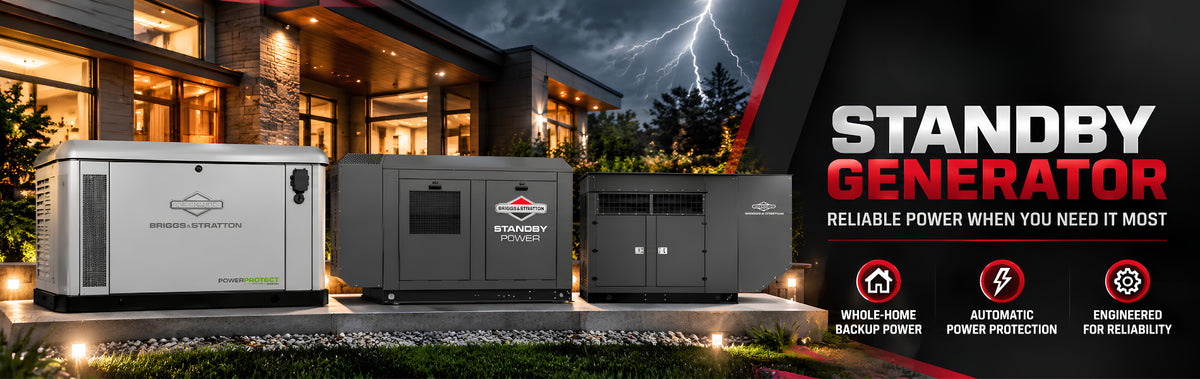
Outages rarely show up at a good time. A summer thunderstorm knocks out the AC in the middle of a heat wave, or an ice storm takes the heat with it in January. Briggs & Stratton standby generators give your home or business its own power source, one that starts up when the grid fails and shuts down when it comes back. They're part of the wider Briggs & Stratton lineup, alongside transfer switches and power management modules.
How Briggs & Stratton Standby Generators Work
Briggs & Stratton standby generators sit outside next to the building and draw fuel from a natural gas line or a propane tank. A transfer switch keeps an eye on utility power. When it drops, the switch signals the generator to start and moves your electrical load over to it, usually within seconds. When utility power returns, everything switches back and the generator winds down.
Unlike a portable unit, a home standby generator never needs refueling by hand, and there are no extension cords running through a cracked-open window. Most models also run a short self-test on a regular schedule, so you aren't left wondering whether it'll start when you need it. If you travel often or have family members at home who rely on power, that hands-off operation matters more than any other feature.
Residential Standby Generators
Our residential generator collection is built around keeping a household running. Depending on the size you choose, that can mean:
- Heating and cooling, so the house stays livable in extreme weather
- The fridge and freezer, so food doesn't go to waste
- Sump or well pumps
- Lights, outlets and Wi-Fi for anyone working from home
- Medical equipment that can't be without power
A Briggs & Stratton home standby generator can be sized to cover a handful of essential circuits or the entire house.
Commercial Standby Generators
For businesses, an outage costs more than comfort. Walk-in coolers warm up, card readers go dark and security systems lose power. A commercial standby generator keeps those systems going for offices, restaurants, clinics, retail stores and small warehouses. Even a short outage can mean spoiled stock, lost sales or a closed door, so for a lot of business owners the generator pays for itself the first time the lights go out. You'll find these larger models in our commercial generator collection.
Choosing the Right Home Standby Generator
- Size it to what matters. Add up the loads you want covered. Central AC, well pumps and electric ranges take the most capacity.
- Check your fuel. Natural gas gives you a steady supply. Propane works where there's no gas line, but tank size affects how long the generator can run.
- Plan the location. You'll need clear space outside with enough distance from windows, doors and vents to meet local codes.
- Pair it with a transfer switch. Without one, the generator can't connect to your panel automatically.
Many households find that a residential standby generator sized for essentials, paired with power management modules, covers what they need. Others would rather have full coverage and never think about which circuits are on.
Ready Before the Next Outage
The best time to sort out backup power is a clear, calm day, not the evening the forecast turns. Compare Briggs & Stratton standby generators by kW output, fuel type and coverage, then line up the transfer switch and any power management modules your setup needs. Getting the full system chosen ahead of storm season means you're not scrambling when everyone else is too.
FAQs
Q1. What size Briggs & Stratton home standby generator do I need?
Add up the wattage of everything you want running during an outage, with extra room for large appliances that draw more power at startup. Then choose a kW rating that covers that total.
Q2. Can a standby generator run on propane?
Yes. Briggs & Stratton standby generators run on either natural gas or liquid propane. Each listing shows the output for each fuel type.
Q3. Is a commercial generator different from a home model?
Commercial models are built for larger electrical loads and the critical equipment businesses depend on. Home models are sized for household circuits and appliances.

